 Lost Tribes Institute
Analysis of the Mikir-Israeli Claim: Ethnic Mikir (Karbi) Descend From Ancient Israel
· Richard Hewitt (Risbek)
Submitted by: United Mikir’s Research Society (UMRS) · Analyzed by: Lost Tribes Institute (LTI)
Also available as a PDF.
Introduction
The Lost Tribes Institute (LTI) was invited to analyze ethnographic data that highlights ethnic Mikir, also called Karbi, descent from ancient Israel. After reviewing the information, the LTI concurs that ethnic Mikir/Karbi people, estimated to be 500,000 (India Times; 2024), are descendants of ancient Israel's Northern Kingdom, which, according to the Hebrew Prophets, was scattered among all nations (Amos 9:9), and which the Prophets say will return to Israel (Jeremiah 31:10). Archaeological evidence from the Middle East confirms the diaspora described in the Script, and recent anthropological studies in Eurasia and beyond affirm the modern-day existence of Israel's non-Jewish, Israelite descendants. Note: the Northern Tribes were not from Judah’s Southern Kingdom, from where modern Jews derive their name.
Challenges and Considerations
Evidence Gaps
Insufficient genetic evidence linking Mikir to ancient Israel challenges the claim of direct descent. Mitochondrial DNA links a small percentage of women to the Middle East, but to date, the male Y-chromosomal link is virtually absent. This has been a problem in our field and in Judaic studies for decades. Genetics is
not as straightforward as we had originally imagined but will be worked out in time.
Central Asians have legends of a group of women being the sole survivors of an attack. By sticking together, the women restarted the tribe. This legend, if true, would explain why Middle Eastern mitochondrial DNA is present, but not Middle Eastern Y-Chromosomal DNA.
Nonetheless, an unusual Jewish genetic marker called G6PD
(Glucose-6-phosphate dehydrogenase) is prevalent among Southeast Asia’s Hill Tribes. Both Mediterranean Jews and Pushtuns have this marker, confirming the evidence for an Israelite connection to the Pushtuns and the Hill Tribes. A study among the Kachin Jingpo showed a prevalence of 27.9% in males and 30.6% in females on the Myanmar-Yunnan border (Li Q, 2015). Mukherjee MB (2015) also records the prevalence of G6PD among India’s North Eastern Hill Tribes. LTI’s own Margot Crossing has three Mizo grandsons from Mizoram. Two have G6PD.
Cultural Diffusion
Observed cultural practices might stem from broader cultural exchanges in Asia rather than a direct lineage from Israel. Yes. This challenge is amplified by the enormous number of interconnected Asian communities that may all be related to Israel. What started as a small trickle of captives and refugees from 10 tribes, became a flood of similar peoples that moved across nations and spawned nations, cultures, religions, and languages along the way.
Dating Migrations
Israel’s scattered “Ten Tribes” are generally believed to be part of Assyria’s 8th Century BCE deportation, but the messianic (or new covenant) correlations between the Mikir Tribe’s “Sot Recho” (Noble King) have caused several local scholars to date one migration to the 70 AD diaspora, when Rome attacked Judea. Additionally, Mikir legends don’t the caves of Sichuan, which is a major stop on the route of other Tibeto-Burmese tribes affiliated with Israel in Northeast India. The Mikir Moserah highlights Kashmir, Tibet, Nepal, Bhutan, and the Himalayas in the migration narratives, suggesting they may have come into India through seemingly insurmountable mountain passes.
These are all topics to be further discussed and researched.
Methodology
The basis for LTI’s conclusion relies on anthropological analysis of Mikir traditions, lore, the Mikir “Honghari” folk faith, migration legends, and the Mikir oral history preserved in their “Moserah” and dirges. The material was presented to the Lost Tribes Institute at four symposiums from November 2023 until the joint LTI-UMRS symposium on December 11 and 12, 2024 in Meghalaya, India. The United Mikir Research Society’s (UMRS) defense of their position that Mikir/Karbi tribes descend from ancient Israel is scholarly and can stand in any honest academic setting.
The United Mikir’s Research Society (UMRS) faithfully interviewed members of the Mikir Honghari folk faith to verify their claims and invited Longsing Bey, a famous reciter of oral traditions (the Mikir/Karbi Moserah) to the December 2024 symposium. LTI was fortunate to interview Longsing Bey after the symposium to verify that the information presented was accurate and historic. Longsing Bey was thrilled to see his culture and traditions reflected in the Good Book. Note: I don’t use the Western word “Bible” to reference this indigenous Eastern Book which appears to be the “lost text” of Mikir and many other Asian peoples (Crossing, 2019).
This analysis leans on other Asian ethnic groups whom the LTI and other scholars confirm to be descendants of ancient Israel. In this assessment, ethnic Kyrgyz are referenced most often. Kyrgyz lore suggests that Kyrgyz kin crossed to the southern side of the Himalayas. By referencing Kyrgyz and other similar tribes, we can see Mikir/Karbi within the larger network of ancient Israelites spread across Asia.
Cultural and Religious Parallels
Monotheism
The Mikir are often considered polytheistic but have a deep-seated and historical monotheistic faith called Honghari, which sets them apart from the surrounding polytheistic cultures. Their monotheism helped Mikir/Karbi preserve their faith, identity, and culture through centuries of oppression and servitude. Their spiritual adherence matches Thomas Torrance’s descriptions of Qiang-Min in Sichuan, China. Torrance argues that the Qiang-min are Israelites. Similarly, the Mikir legend and the legend of other similar tribes in NE India acknowledge at least one migration from Sichuan.
"Hempu" is the most common title for the Almighty in the Mikir/Karbi tradition, but the Moserah (the oral history of Mikir/Karbi) references two powers, Ji and Hova. These names appear to derive from "Jihova" or "Jehova," a variation of the Hebrew name for God (Migration Memories, p. 8). Another Mikir name for God is "Yahwek." The Lost Tribes of Israel (LTI) research often finds variations of "Yah" or "Yahweh" among the scattered tribes of Israel. According to the Moserah, Mikir lived alongside the children of Ji and Hova. Ethnographers generally agree that Ji and Hova's people are Jews. These two deities might represent the plurality often used to address the One God in many monotheistic traditions. (Recently, Mikir have adopted Hinduism and Christianity which Mikir/Karbi clans consider foreign.)
Mikir monotheism may have come from Zoroastrianism or the Hindu Vedas which originated as monotheistic. Additionally, the Lost Tribes Institute also sees evidence that both Zaroastor and the later Vedas were also influenced by Israelites and/or Jews. The Mikir/Karbi core is strongly monotheistic and this is indicative of an Israelite origin.
The Three Religions of Karbi/Mikir Tribes
Mikir Christians argue that their parents and grandparents received Christianity because scripture paralleled their traditions and appeared to be a type of national restoration. Unfortunately, Mikir Christians are now abandoning their scriptural traditions for a Western form of Christianity.
Hindu Vedas affirm Hinduism’s foundational belief in One Creator God, but Mikir converts to Hinduism probably converted because of Hinduism’s proximity to and influence over Mikir populations, a pattern that exists at the edges of other minority populations. Unfortunately, our research has not yet included Karbi Hindus.
Honghari, the indigenous folk faith, is often considered animistic, which suggests that Mikir/Karbi believe objects have a spirit. Ancient Israel also mixed monotheism with the worship of neighboring gods, some of whom were gods of nature’s various elements (mountains, valleys, fire). That may sound counterintuitive. They believed in the Almighty but adopted other gods and religious practices from foreign sources. Despite all this, Mikir disavow idol worship.
Written Text
The Lost Tribes stretching north and south along the Hindu Kush-Himalayan region from Myanmar to Kyrgyzstan have stories of a Lost Book. Among the Mikir, we heard stories of different lost texts. The most common version was a sacred text that was written on tree bark. The prized bark-book was eaten by the people during a famine. Longsing Bey, a traditional teller of the Moserah, confirmed that their text had been written on bark and stones (December 12, 2024). The Mikir Hills have various trees including banana trees with smooth bark which may have depicted their ancient script. “Kitab Lo” is another name of the lost book, referenced in Sonoram Rongphar’s research paper. “Kitab Lo” is simply two different words for “book”. Kitab is a Semitic word for writing or book that stems from the Hebraic consonantal word, K-T-B.
East of Nowgong District, Mikir speak of a book that was written on buffalo-skin scrolls which were eaten by rats which were sent by demonic forces who wanted to keep the Mikir people ignorant (UMRS p. 4). To this day, Mikir, who educate themselves, fear a dark curse. This curse on a nation’s intellect parallels a depiction in the Kyrgyz Epic, Manas, which depicts the enemy burning the Kyrgyz scroll to keep Kyrgyz minds darkened (Жакыпбеков p. 12). Again, Mikir not only trace their origins back to Israel but fit within a network of nations with Israelite roots.
Blood Sacrifices
Mikir, like many indigenous tribes, offer blood sacrifices to both their monotheistic God, Hempu, and also to lesser deities. Goat and fowl sacrifices are most common, but, contrary to the Script, pigs are also sacrificed. Animals are sacrificed to appease Hempu for blessings on the crops and for protection. Pig sacrifices are the antithesis of God’s commands, but such contrary data doesn’t exclude Mikir from being Israelite. Even the Script highlights Israel’s northern tribes eating pork 2800 years ago (Isaiah 65:2-4).
Across the Mikir regions, different clans report applying sacrificial blood to doorposts, a practice that mirrors ancient Israel’s Passover (Exodus 12 & 13). This practice has also been noted among ethnic Karen in northern Myanmar and past generations of ethnic Kyrgyz.
Blood is also sprinkled on the small earthen altars that Mikir shovel together during a ceremonious dance. Sprinkling blood on the altar is a common practice of ancient Israelites (Leviticus 1:5). The Mikir altar is not very impressive, but serves as a temporary site for ceremonial sacrifices.
Two permanent altars in Mikir lands were mentioned. One needs to be cleared each year for an annual festival. The other site has since come under Kashi ownership and is no longer used by Mikir tribes.
Drink Sacrifices
Mikir pour water and other drink offerings on their dirt altars. The Script also contains similar drink offerings (Nothengpi, Karbi Heritage Museum, December 13, 2024).
Priests
Like ancient Israelites, Mikir have priests who must purify themselves and wear priestly garments during ceremonies. And like both Israelites and Kyrgyz, they use incense in their ceremonies for purification.
The Mikir clan “Kathar” is the priestly clan I met while among the Mikir. Israel’s priests are called Kohen. The H in Kohen can become TH through phonetic aspiration, and phonetically the N can become R through Rhotacism. Phonetically, the consonantal K-H-N of Kohen can become K-TH-R of Kathar. That would not count as evidence if the rest of the Mikir case wasn’t solid.
Ceremonies & Feasts
The Symposium’s most dynamic presentation was Jendro Klein’s well-documented comparable analysis of Israeli and Mikir ceremonies. There are far too many to discuss here, but his slideshow can be found in the symposium’s book along with other presentations. Needless to say, Mikir ceremonies have many scriptural parallels. Some scholars dismiss these similarities as archetypes, but anthropology needs to reconsider its view of archetypes and universal consciousness considering our present understanding of ancient migrations.
Monoliths
Mikir, like ancient Israelites and Kyrgyz, have monoliths throughout the land which can be as simple as an erected stone like the one Jacob erected when given a promise from God (Genesis 28) or with text like the Kurkh Monoliths in Northern Israel.
Cultural Narratives
Machir, son of Manasseh
Christian Mikir sources point out the similarities between the ancient tribal name Mikir and the Script’s Machir clan which is recorded as one of Manasseh’s clans. Manasseh is significant for our research in Asia because the majority of “Lost” Israelites we’ve worked with in Asia identify as descendants of Manasseh. These same nations are closely related to Mikir/Karbi. The related tribes (Kuki, Mizo, and Chin) are accepted by modern Israel as ancient descendants of Israel’s Tribe, Manassah. Additionally, scholars like Dr. Avigdor Shachan, who quotes numerous sources, highlight the 2700-year preponderance of evidence highlighting Manasseh’s tribe in Central Asia and beyond. Jewish enclaves in Kranganur, Kerala also claim descent from Manasseh’s tribe. The Manassites and Nephtelites are the most documented Israelite tribes in Asia.
Mikir are part of a fascinating network of Asian tribes, including a distant connection with modern Kyrgyz who have a well-documented history stemming from Manasseh’s Tribe. The Kyrgyz hero, Manas son of Jakyb, appears to be the Script’s “Manasseh son of Jacob” (Hewitt, 2012). The Kyrgyz epic Manas mentions kin who live on the other side of the Himalayas in thick jungles with tigers, monkeys, and thieves. The comparative analysis with Mikir (Karbi) and other groups with Israelite affinities to ancient Israelite customs fits into the larger body of evidence confirming a strong Israelite presence throughout Asia.
Twelve Leaders
Multiple sources confirmed that Mikir have a creation story with a giant extinct bird that laid 12 eggs which hatched into the twelve original leaders of the Mikir. One source referenced these as 12 brothers (UMRS, p. 7-8). This is significant since ancient Israel formed around the 12 sons of Jacob (Israel). These 12 brothers became the leaders of Israel’s 12 tribes.
According to tradition, Mikir land has also been divided into 12 portions even though there are only 5 Mikir tribes. Under Joshua, Israel’s land was divided into 12 tribal territories (Joshua 15-19). Likewise, Kyrgyz divide a lamb’s carcass into 12 parts in remembrance of their 12 original tribes. Today, Kyrgyz have more than 12 tribes.
Oral History - Moserah
The Mikir “Moserah” is an oral retelling of Mikir history, customs, and migrations. Their Moserah narrative may take its name from the Script’s Moserah, one of Israel's campsites on their migration from Egypt to Canaan. On that journey, the Israelites were commanded to repeat their history to their children. Moserah is the place where Israel’s High Priest died, and the priesthood passed to the next generation. Likewise, Moserah would have been the place where one Israelite generation recited their history, practices, and migrations to the next generation.
Kyrgyz have an oral history that is recited in an identical rhythm to the Moserah’s slow version which Longsing Bey recited on December 12, 2024, in Plasa, Meghalaya. The similarities with Kyrgyz and other Israelite tribes support the data that Mikir/Karbi are within the network of Asia’s ancient Israelite communities.
The Mikir Moserah mentions crossing an Ocean like Israel’s Red Sea crossing. Additionally, the Moserah reminds Mikir that they originated from the “Navel of the World” or the “Center of Earth” which is a colloquial definition of “Zion”.
Oral history and linguistic analysis strongly suggest one migration came through Yunnan and Burma. Karen, Karbi/Mikir, and Kuki-Chin all belong to the Tibeto-Burman branch of the Sino-Tibetan linguistic family (Post, pp. 213–242), but these tribes all mention Shinlong, the caves high above Chengdu. Sinlong or a variation of that name is missing from the Mikir migration narratives.
Other sources say the Mikir came from Punjab or over the Himalayas (Barua (pp. 23–25). The Vedas’ use of “Kirat” for Indo-Mongoloids who have therefore been in the subcontinent since the Later Vedic Period which concluded circa 500 BC.
Karbi megaliths also suggest an early migration. Additionally, oral history indicates the Mikir were influenced by Buddhism from Tibet and/or Nepal. The Moserah which suggests Mikir came through Tibet and Nepal, where Buddhism thrived. And some scholars suggest Mikir ancestors came from Bhutan. Obviously, there was not one migration.
The Kyrgyz epic “Manas” mentioned earlier suggests trade, communication, and aid passed back and forth through and around the Himalayas. Bhutan and Northern Assam, directly north of the Mikir Hills, name a river and park “Manas” in a region full of thick jungles and tigers. Bhutan is referenced as one migration site in Mikir oral tradition, so we can assume descendants of Manasseh’s Tribe from Machir’s Clan passed this way also. Mikir/Karbi appear to be a conglomeration of various migrations through mountain passes that are still accessed in summer months by pilgrims and hikers.
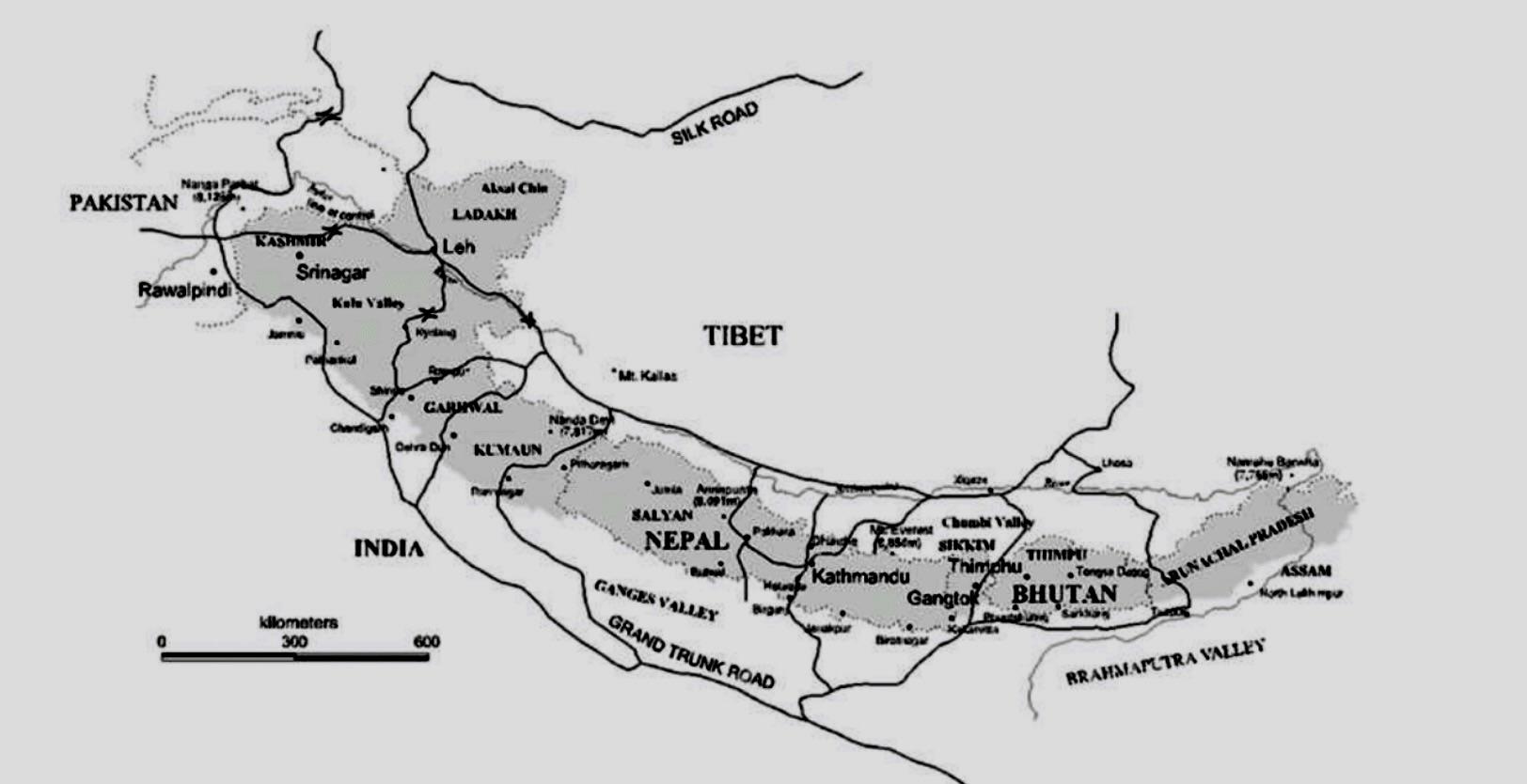
Ancient Routes from Tibet, Central Asia, and China into Northern India, Nepal, and Bhutan
Oral histories are like archeological sites that contain broken fragments. Rarely does one find a complete set in the earth or a complete story in oral traditions. Anthropologists, like archeologists, recognize patterns from fragments within multilayered oral histories that grew century after century. We recognize patterns from anthropology’s core text, the Sacred Script, which is the basis for countless cultures and faiths. There is no other book that dignifies each micro-culture by embracing an all-inclusive position toward a multitude of indigenous faiths while simultaneously staying true to a clearly defined doctrine.
Tattoo
Scripture does not permit Israelites to tattoo themselves. While some Mikir women have tattoos, both ethnic Mikir and Kyrgyz condemn tattoos (Lyall, p. 6).
Moses Staff
Like Kyrgyz and Qiang-min, Mikir have a sacred staff used by holy men. The Kyrgyz and Qiang-min version is spiral wood. The Mikir version is straight, but all three ethnicities refer to this as a Moses staff.
Sot Recho
From Kyrgyzstan to Japan, and from Siberia to India, we have discovered that ethnic groups with connections to ancient Israelites share a peculiar belief in a messianic figure within their customs and faith. The Mikir culture exemplifies this intriguing pattern. The Mikir believe in a Humble King, known as Sot Recho, who was rejected by his people, killed, yet remained unkillable. He is prophesied to return (Rongphar, 2024), aligning with scriptural depictions of a Messiah who was killed and promises to return.
Although the messianic figures vary across cultures, the Script’s Jesus, whom Mikir call Jizu, fits every typology we have examined, from the Peace Child of Papua New Guinea to Shunu of Altai, Sot Recho of Mikir, the Wandering Kydyr of Kyrgyzstan, and many more.
One explanation for this messianic phenomenon can be attributed to Jesus’ edict to his followers to go to the “lost sheep of Israel” which is the Prophet Ezekiel’s metaphor for Israel’s scattered tribes (Ezekiel 36). A handful of scholars believe Jesus’ followers proclaimed Jesus' story and teachings to their scattered kin during the first millennium AD. Eastern Nestorians are one faith movement that actively sought “Israelites”. (Note, I don’t call Nestorians Christian because parallel groups in Asia didn’t self-identify as Christian, just as Messianic Jews refuse to identify as Christian.) Needless to say, the Moserah’s Sot Recho is another indicator that Mikir are Israelites.
Conclusion
This paper is intended to be a summary of the data that swayed the institute’s decision. Many more cultural parallels could have been added but weren’t because of lack of time or lack of appropriate citations. Legendary characters in Mikir folk stories partially match biblical characters. Sum and Sang match Abraham and Sarah - a childless, older couple who give birth well after their time had passed. This is a significant parallel, especially in light of all the other “connected dots” but this type of information abounds and will be included in later comparative analyses. Other legends or practices weren’t added for similar reasons. This remains a recap of vast amounts of material gathered by the United Mikir Research Society. God willing, there will be many more symposiums that will build on the UMRS’s research.
The LTI conclusively states that the Mikir/Karbi Tribe is Israelite in origin and fits within the network of Asian peoples descending from Manasseh and Israel. The evidence presented and the resulting conclusion sync with the foretellings of humanity’s most critiqued, translated, and published Book. The UMRS researchers financed and organized their scientific symposium, successfully presented their culture and data on the international stage, and defended their case at an academic level. May their hard work and fascinating discoveries be recognized.
Richard Hewitt
Margot Crossing
Lost Tribes Institute
Reference
Barua, B.K. (1969). A Cultural History of Assam. Bina Library.
Chen, Ester. (2012). The Hidden Qiang, “Sons of Sheep” (Electronic Version, Sichuan, Chengdu, China)
Chung, Ha-Sung; (2021, December 27) How Did Buddhism Spread So Easily in the Far East? On the Relationship Between Buddhism and Israelitism. Academia.comhttps://www.academia.edu/66108657/How_did_Buddhism_Spread _so_easily_in_the_Far_East_On_the_relationship_between_Buddhism_and_Isra elitism_Discussion_paper
Chung, Ha-Sung, Dr.; Dispersion of the Israelites in the Eurasian Continent: How GOD has fulfilled His Promise: History of Eurasia from Biblical Perspective (Independently published, 2023)
Collins, Steven M. (1995). The Ten Lost Tribes of Israel… Found! CPA Books
Conze, Edward. Buddhist Scriptures. Penguin Classics, 1959.
Crossing, Margot; Lost Book Peoples; Connecting Northeast India to Central Asia through Oral Tradition, (World Epic Festival, Scientific Symposium, Bishkek, 2019)
Eidelberg, Joseph. (2005). Biblical Hebrew Origin of the Japanese People (Gefen Publishing House, Jerusalem, Israel)
Gade, Anne Katrine. (1988). Who Were the Cimmerians and Where Did They Come From? (The Royal Danish Academy of Sciences and Letters) Gertoux, Gérard. (2015). Dating the reigns of Xerxes and Artaxerxes (researchgate.net)
https://www.researchgate.net/publication/312069819_Dating_the_reigns_of_Xerxes_and_Artaxerxes (May 5, 2024)
Girard, René. (1987). Things Hidden Since the Foundation of the World (Stanford University Press)
Grant, Asahel; (1841) The Nestorians, Or, The Lost Tribes (Harper and Brothers)
Halkin, Hillel (2002). Across the Sabbath River in Search of the Lost Tribes of Israel (Boston, Houghton Mifflin Company)
Hanh, Thich Nhat; 1995) Living Buddha, Living Christ - 20th Anniversary Edition (Richmond Books, New York)
Haokip, PS; (2023, November). Manasseh People and Their Settlements; (Lost Tribes Institute’s 1st International Symposium; Aizawl, Mizoram, India).
Heschel, Abraham Joshua (1962). *The Prophets*. New York: Harper & Row
Hewitt, Richard (Risbek). (2006). A Comparative Analysis of Kyrgyz Jakyb and Jacob the Prophet (First International Festival of Epics, Bishkek, Kyrgyzstan)
India Times. (2024, February 24). Honoring their heritage, Assam’s Karbi tribesmen set world record by walking on bamboo stilts for 10 minutes. https://www.indiatimes.com/news/india/assam-karbi-tribesmen-set-world-record-walking-bamboo-stilts-628317.html
Jacobovici, Simcha (Director). (2006). Quest for the Lost Tribes of Israel [Film, DVD release] A&E
Khalidi, Tarif; (2001). The Muslim Jesus: Saying and Stories in Islamic Literature. Harvard University Press.
Khuplam, Milui Lenthang. (2013). The Wonderful Genealogical Tales of Manmasi (Kuki-Chin-Mizo). Maxford Books.
Klein, Jendro; (2025, December) “Bible & Mikir Comparison” Slideshow; Plasa, Meghalaya.
Kubo, Arimasa (2022, July 25) “Israelites Came to Ancient Japan” https://remnant-p.com/isracame.htm
Lhungdim, David. (2021). Menashe - Manmasi the Lost Tribe of Israel (Shivtei Menashe Publications)
Li Q, Yang F, Liu R, Luo L, Yang Y, Zhang L, et al. (2015) Prevalence and Molecular Characterization of Glucose-6-Phosphate Dehydrogenase Deficiency at the China-Myanmar Border. PLOS ONE 10(7): e0134593.
doi:10.1371/journal.pone.0134593
Lyall, Sir Charles; The Mikirs (Mittal Publications, Delhi, 1905)
Mangalwadi, Vishnu. (2011). The Book That Made Your World: How the Bible Created the Soul of Western Civilization (Thomas Nelson)
Moore, George MD. (1861). The Lost Tribes and the Saxons of the East and the West, with New Views of Buddhisms, and Translations of the Rocks-Records in India (London, Longman and Brothers)
Mukherjee MB, Colah RB, Martin S, et al. (2015) "Glucose-6-phosphate dehydrogenase (G6PD) deficiency in Indian populations: A review." Indian Journal of Medical Research 141(5): 567–573. doi:10.4103/0971-5916.159281
Nagami, Kengo Dr.; Author of “Japanese and Jews”; Personal communication throughout 2023
Nothengpi, Karbi Heritage Museum (2024); Diphu, Assam, India Orozbakov, Sagymbai (2004). “Manas” Translated by Walter May (Bishkek, Rarity Press, 2004)
Post, Mark W. (2017). "Northeast Indian Tibeto-Burman Languages." In The Sino-Tibetan Languages, Routledge
Richardson, Don. (1984). Eternity in Their Hearts (Regal Books, Ventura, CA)
Riegert, Ray; Moore Thomas; (2003). The Lost Sutras of Jesus (Ulysses Press, Canada)
Rongchon, Ujan; (2024, December). “Monolith (Long-e) of Mikir Ethnic.” (LTI-UMRS Symposium, Plasa, Meghalaya, India).
Rongphar, Sonogram; (2024, December). “A Comparative Analysis of Two Humble Kings - The Biblical King and the Mikir King”; (LTI-UMRS Symposium, Plasa, Meghalaya, India).
Schmidt, Wilhelm, (reprinted 1983) The Origin of the Idea of God. (University Press of America)
Shachan, Avigdor (2007) In the Footsteps of the Lost Ten Tribes; (Devora Publishing Company)
Teron, D. “Migration Memories” in Karbi Oral Tradition (karbi.wordpress.com) https://karbi.wordpress.com/2007/12/19/%E2%80%9Cmigration-memories%E2%80%9D-in-karbi-oral-tradition/#:~:text=Introduction%3A,exotic 7/5/22
Torrance, Thomas; (2nd edition, 1988). China’s First Missionaries; Ancient Israelites. (Daniel Show Publisher)
United Mikir Research Society; A Disquisition of Karbi (Mikirs); A Search for the Lost Tribe (United Mikir Research Society; Nongpoh Meghalaya, India; 2024)
van Driem, George (2001). Languages of the Himalayas. Brill. Traces Tibeto-Burman dispersal, framing Kuki, Karbi, and Karen within this spread (pp. 379–399).
Williams, Jay G.; (1978). Yeshua Buddha; (The Theosophical Publishing House, Wheaton, Ill)
Zephyr, Alexander; (2013). Rabbi Akiva, Bar Kokhba Revolt, and the Ten Tribes of Israel (San Bernardino, iUniverse)
Zhang, et al, (2022, July 25). A Late Pleistocene human genome from Southwest China, Current Biology,
https://www.cell.com/current-biology/fulltext/S0960-9822(22)00928-9?_returnURL
Zaithanchhungi. (2008). Israel-Mizo Identity (L.N.Thuanga “Hope Lodge”)
Zimmer, Heinrich. (1951) Philosophies of India. Princeton University Press Жакыпбеков, Ашымбек; Теңири Манас