 Lost Tribes Institute
Israelites Became Scythians in Urartu
· Richard Hewitt (Risbek) - Lost Tribes Institute
One people vanishes, another appears
Around 721 BC the northern kingdom of Israel dropped out of the record. Within a generation a new people rode onto the stage just to the north: the Scythians. Steven M. Collins, author of the four-volume series on the migrations of Israel’s famed Lost Ten Tribes, argues that this is one story, not two. The Israelites did not disappear. They changed their name.
Collins puts the hinge of that change in a specific place: the highlands between the Black Sea and the Caspian, the land the Assyrians called Urartu and the Bible calls Ararat. In his telling, Israelites went into Urartu as refugees and came out as Scythians.
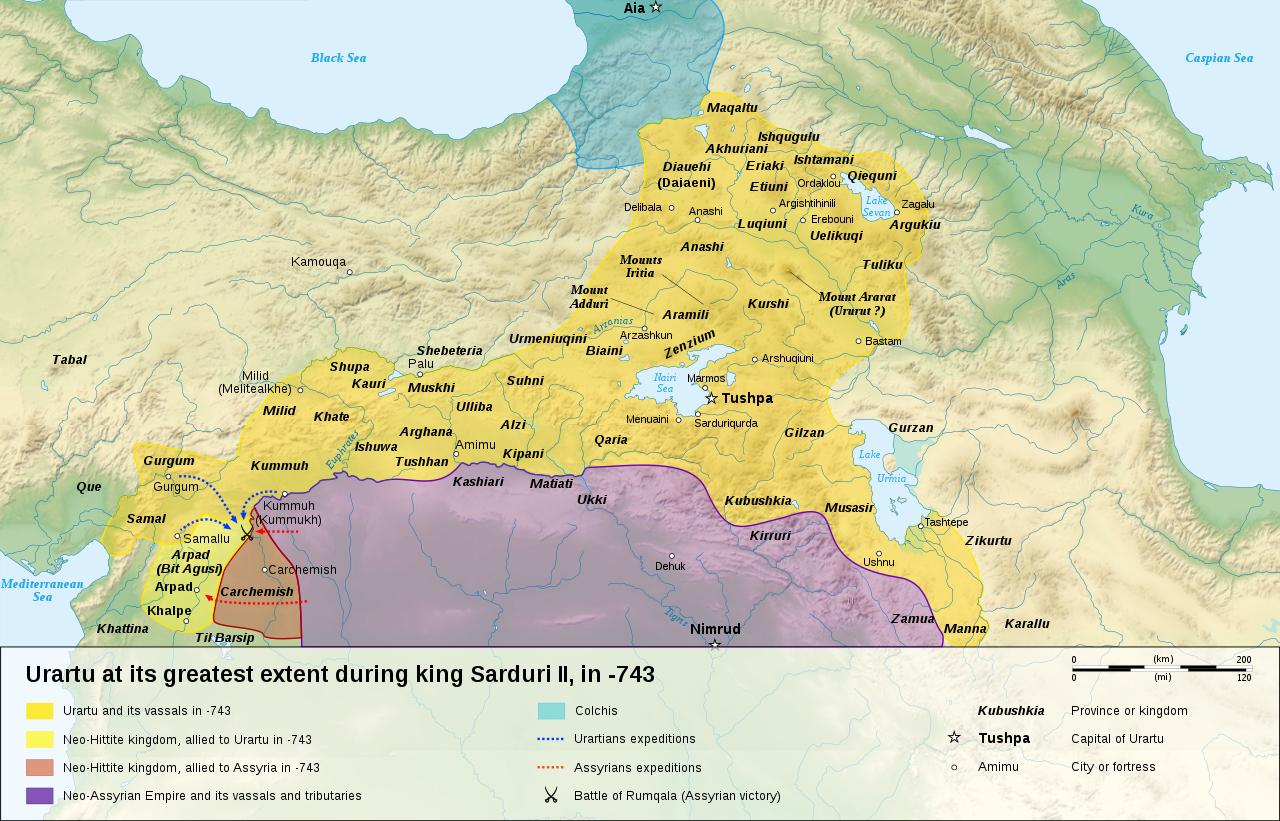
Urartu at its greatest extent under King Sardur II, about 743 BC, a generation before Samaria fell. Assyria is shown in purple to the south. Map by Sémhur, CC BY-SA 4.0, via Wikimedia Commons.

Why Urartu
Two groups left Israel, and only one was in chains. Collins separates the captives from the fugitives. The captives had no say in where they went. Assyria marched Naphtali and the tribes east of the Jordan away first (2 Kings 15:29), then settled Samaria's survivors in Halah, Habor and the cities of the Medes (2 Kings 17:6). Collins treats that last group as the smallest. The larger body, he says, saw the end coming and left on its own terms, with flocks, families and fighting men. He leans on the medieval Jewish traveler Eldad, who described a chief able to field 120,000 horsemen and 100,000 foot soldiers, and concludes that well over a million people were on the move.
Free people run to where the enemy cannot follow. A fugitive from Assyria had one sensible direction: north, into the mountains of Assyria's old rival. Urartu had fought Assyria for two centuries. Its high valleys around Lake Van, Lake Urmia and the Araxes were hard to invade and easy to defend. Collins reads 2 Esdras 13 the same way: the tribes chose a far country, "Arzareth," which he locates in the Black Sea and Caucasus region. He adds Jeremiah 3:12, where the prophet is told to call to Israel "toward the north." North of Jerusalem, past Assyria, is Urartu and the Black Sea.
The timing fits. Collins cites Tamara Talbot Rice: Assyrian records first place Scythians near Lake Urmia in the reign of Sargon II (722–705 BC), the same king who finished off Samaria. Rice also notes the Scythians were not a recognizable nation before the eighth century. For Collins this settles the direction of travel. A people who first show up on Urartu's southern edge, coming by a route south of Armenia, did not ride in from Siberia. They walked up from Palestine and filled a vacuum they knew existed.
Urartu was weak enough to take. Sargon gutted Urartu in 714 BC. The incoming Israelites displaced what was left and planted their own kingdom on its soil. He quotes William Culican that Urartu was worn down by Scythian raids, and he points to the Scythian king Partatua, whose capital was Sakiz. Collins's use of this quote assumes the Israelites were the Scythians. Collins reads both names as Hebrew: Sakiz for Isaac, and Partatua as "Bartatua," built on the root for covenant (berit). His list is more substantial.
What came out of Urartu
Collins's test is simple. If Israel went in, something of Israel should come out. He finds it in three places.
The name. Genesis 21:12 says Abraham's line would be named through Isaac, and Amos 7:16 calls the northern kingdom "the house of Isaac." The Persians called every Scythian Saka, the Greeks called them Sacae. Strip the vowels and Isaac and Saka share the same consonants. The Scythians were carrying the family name.
I have heard this habit with my own ears. My Kyrgyz name is Irisbek (Ырысбек). The Kyrgyz, descendants of the Scythians, still drop the opening vowel and call me Risbek, just as their forebears dropped the opening vowel of Isaak and said Sak. To this day, they call the Saka, Sak.
The habits. Herodotus reports that the Scythians kept no pigs and offered none. He also tells of two Scythian royals, Anacharsis and Scyles, put to death by their own people for taking up Greek religious rites. Collins sees a people who had left the land but kept the Torah’s food laws and hatred of idols. He adds a Scythian king named Saulius, a Hebrew name, and the Massagetae east of the Caspian, whose name he ties to Manasseh.
The road home. Around 620 BC the Scythians swept south through Assyria's empire and down the coast of Israel. Herodotus says they harmed no one on that march. Israel’s Beth-Shan was afterward called Scythopolis. Collins lines this up with Josiah's Passover in 2 Chronicles 34–35, where people of Ephraim and Manasseh appear in the land again. The Scythian riders from the north returned to their former land for 28 years.
So Urartu is, for Collins, the place of conversion from Israel to Gentile (nations). Farmers and townsmen from Samaria left Israel with horses from Solomon’s glory days. A mounted nation with tech from Solomon’s building project quickly dominated the Eurasian continent.
Pushed back
Most historians and archaeologists reject this. They hold that the Scythians were Iranian-speaking nomads who came west off the Central Asian steppe, and that the Saka name is Iranian, not Hebrew. They treat consonant matches like Saka and Isaac as chance. One detail in Collins's own case also needs care: Sakiz (modern Saqqez) lies south of Lake Urmia in what was the kingdom of Mannaea, on Urartu's edge, not in Urartu proper.
Collins's reply is that the consensus explains where a steppe culture came from but not why this people surfaces beside Assyria in the very years Israel goes missing, avoiding pork and killing its own kings over idols. Archaeology does confirm part of his setting: Scythian arrowheads and gear turn up in the ruins of Urartian fortresses. Who those Scythians were before they got there is the open question. Collins's answer is scholastic. He states the Scythians were ancient Israel.
Sources
- Steven M. Collins, The Israelite Origin of the Scythians
- Steven M. Collins, Israel's Lost Empires, book overview and excerpt
- Sergey Makhortykh, The Scythians and Urartu
- Scythians, Wikipedia, for the mainstream account of Scythian origins